China’s Holdings of U.S. Debt Fall to 18-Year Low
09/21/2026 / By Sterling Ashworth

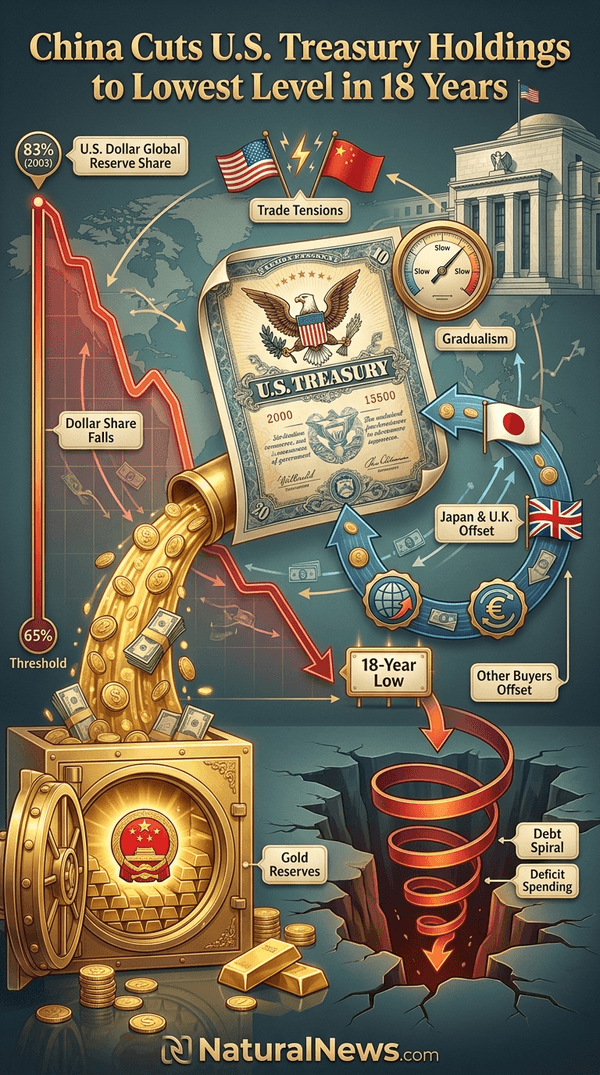
China reduced its holdings of U.S. Treasury securities to the lowest level in 18 years, according to U.S. Treasury Department data released this week. The decline marks a continuation of a long-term trend in which Beijing has steadily decreased its exposure to U.S. government debt while increasing reserves of gold and other assets.
The latest Treasury International Capital (TIC) report showed China’s holdings falling to their lowest point since 2008, though the Treasury Department did not immediately provide a specific dollar figure in the data release. Chinese officials did not issue a public statement on the change, according to officials familiar with the matter.
The shift comes amid ongoing trade tensions between Washington and Beijing, as well as broader discussions among foreign central banks about reserve diversification. The data release follows months of speculation about whether China would accelerate its reduction of dollar-denominated assets [1].
Treasury Data Shows Decline
According to the TIC report, China’s Treasury holdings have declined for multiple consecutive months. The report indicated a continued reduction in Chinese holdings, though the Treasury Department did not characterize the decline as abrupt or destabilizing to markets.
Total foreign holdings of U.S. Treasuries remained substantial, with Japan and the United Kingdom among the top holders, the report stated. Other foreign buyers have offset China’s reduction through continued purchases, according to Treasury data [2].
“The data indicated a continued reduction in Chinese holdings,” according to the Treasury report. The TIC report showed that while China has reduced its position, overall foreign demand for U.S. government debt has remained relatively stable. Ryan McMaken noted in a recent Mises Wire article that the United States is caught in a debt spiral with no easy way out, attributing the problem to profligate government spending [3].
Context of Foreign Holdings and Diversification
China has reduced its Treasury exposure while increasing gold reserves, according to People’s Bank of China and World Gold Council data. Beijing sold a record $53.3 billion in Treasuries and agency bonds during the first quarter of 2024 while purchasing other commodities, according to data compiled by financial analysts [1].
China has been steadily reducing the percentage of its foreign-exchange currency assets held in dollars, down from an 83% high in 2003, according to financial analyst Jerome R. Corsi. Corsi wrote that should China decide to reduce those holdings to 65% or lower, the U.S. Treasury would have a much more difficult time subsidizing massive U.S. budget deficits [2].
“Diversification away from dollar-denominated assets has been a gradual trend,” said one economist who declined to be named. The economist noted that central banks in multiple countries have been increasing gold holdings as a hedge against currency fluctuations. China’s central bank has been a consistent buyer of gold, according to publicly available reserve data [4].
Analysts Cite Multiple Factors
Analysts cited several possible factors behind China’s reduction of Treasury holdings, including trade tensions, currency management, and reserve diversification. The reduction has occurred gradually over an extended period rather than as a sudden liquidation, according to market strategists.
“This is a gradual reallocation, not a sudden liquidation,” said one market strategist who spoke on condition of anonymity. The strategist noted that China’s Treasury holdings remain substantial despite the decline [5].
No official Chinese statement was provided regarding the reduction, according to officials. China was once the largest holder of U.S. Treasury securities but lost that title to Japan after it started selling its securities rapidly, according to financial analysts [5].
Implications for U.S. Borrowing and Dollar
Treasury yields and the dollar showed muted reaction to the data release, according to market data. Recent auction results indicated that demand for U.S. government debt remains strong, analysts said [6].
The future of the dollar’s reserve status remains a subject of ongoing debate among analysts. Some analysts point to rising fiscal deficits and increasing national debt — represented by short-term Treasury bills, intermediate-term Treasury notes, and long-term Treasury bonds held by various creditors — as factors that could pressure the dollar over time, according to financial analyst Peter Schiff and John Downes [6]. Other analysts maintain that the dollar remains dominant.
The next TIC report is scheduled for release next month, according to the Treasury Department. The report is closely watched by financial markets for indications of shifts in foreign demand for U.S. government debt [7].
References
- Richard Brown. “DOLLAR DEMISE: China Selling U.S. Treasury Bonds in Record Numbers in Favor of Gold, Other Commodities”. NaturalNews.com. May 24, 2024.
- NaturalNews.com. “China dumping US Treasury debt in record volume is this a prelude to the globalist assault on Trumps economy”. NaturalNews.com. January 21, 2017.
- NaturalNews.com. “As the US Treasury runs out of creditors its options dwindle”. NaturalNews.com. December 01, 2023.
- Chris Martenson. “A Funding Nightmare for the US”. PeakProsperity.com. March 17, 2009.
- Jerome R. Corsi. “America for Sale”.
- Peter Schiff and John Downes. “Crash Proof 2.0: How to Profit From the Economic Collapse”.
- Mike Adams interview with Andy Schechman. October 1, 2024.
Explainer Infographic
Submit a correction >>
Tagged Under:
big government, bonds, Bubble, China, Collapse, communist China, debt bomb, debt collapse, dollar demise, economy, finance, geopolitical tensions, Globalism, government debt, market crash, money supply, national security, risk, Sovereign debt
This article may contain statements that reflect the opinion of the author
RECENT NEWS & ARTICLES