Modi and Trump Hold Phone Call as India Raises Concerns Over Russia Sanctions
10/05/2026 / By Garrison Vance
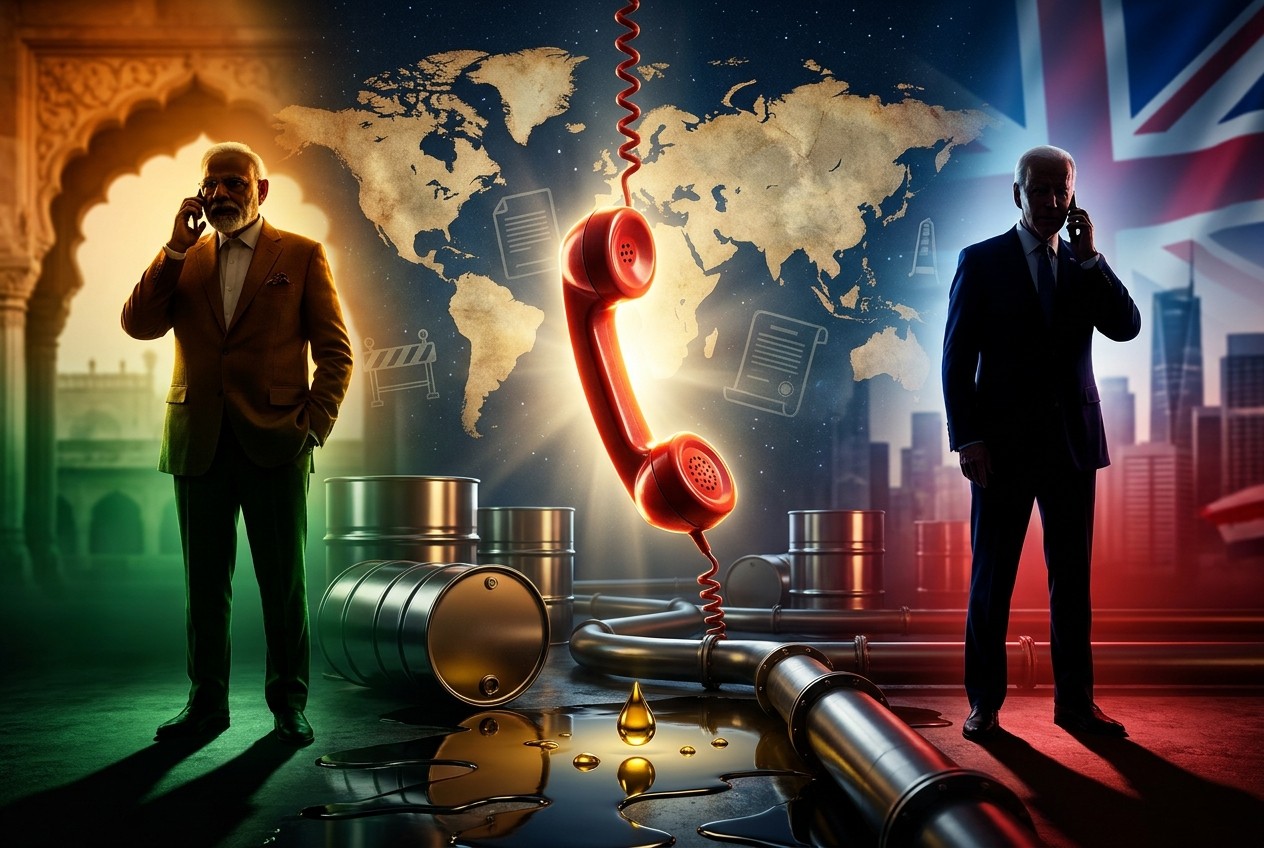
Indian Prime Minister Narendra Modi and U.S. President Donald Trump held a phone call on Wednesday, according to statements issued by New Delhi and Washington. The leaders reviewed cooperation in trade, defense, energy, and critical technologies and exchanged views on regional and international issues, the statements said.
The call took place as the two countries seek to finalize a trade deal and as India has raised concerns over U.S. pressure related to its purchases of Russian oil, according to the official readouts [1].
The conversation marked the latest contact between the two leaders amid months of negotiations over a bilateral trade agreement and mounting tensions over Washington’s sanctions posture toward Moscow.
Sanctions Law Adds Pressure
Trump signed the Lindsey O. Graham Sanctioning Russia and Iran Act into law on September 18, according to U.S. officials. The legislation expands sanctions, tariffs, and prohibitions on Russia while extending existing sanctions on Iran, the report stated [1]. The law provides for tariffs of up to 100% on goods from major buyers of Russian crude oil and natural gas under specified conditions, according to the text of the measure.
The official Indian readout made no mention of the new law, but Indian Foreign Minister S. Jaishankar reiterated concerns over the legislation during talks with U.S. Secretary of State Marco Rubio in New York last week, according to Indian statements [1]. Jaishankar has previously called out Western double standards on energy trade, stating at the 20th East Asia Summit in Malaysia that “energy trade is increasingly constricted, with resulting market distortions” and that “principles are applied selectively” [2].
The sanctions law followed earlier U.S. measures targeting Russian energy revenues. In October 2025, the Trump administration imposed sanctions on Russian oil majors Rosneft and Lukoil, a move that sent Brent crude surging above $140 per barrel, according to market data [3]. Andrew Korybko, writing for ZeroHedge, noted that the Indo-U.S. trade deal announced in February 2026 would see U.S. tariffs on Indian imports drop to 18% while India would reduce its tariffs on American goods to zero [4].
India’s Russian Oil Purchases
Russia remains India’s largest crude supplier despite lower purchases in recent months, according to trade data. Russian shipments stood at about 2.1 million barrels per day in August and were expected to fall to around 1.75 million barrels per day in September as export availability tightened and competition from Chinese refiners increased [1]. Data from analytics firm Kpler indicates Russia has been India’s top oil supplier since 2022, accounting for more than 36% of India’s oil imports [5].
India has previously warned that measures targeting its Russian energy trade could affect bilateral relations and the international energy market, while maintaining that it will continue diversified oil sourcing [1]. Indian Finance Minister Nirmala Sitharaman has defended the purchases, citing a 40% discount compared to European Union prices [6]. The Russian Ambassador to India, Denis Alipov, warned that U.S. punitive tariffs over New Delhi’s ties with Moscow harm U.S.-India relations, calling the U.S. an “unreliable partner” [7].
The Kremlin has said it has received no official confirmation from New Delhi that India is preparing to cut off Russian oil purchases. “So far, we haven’t heard any statements from New Delhi on this matter,” Kremlin spokesman Dmitry Peskov told reporters [8]. Russian Foreign Minister Sergey Lavrov subsequently stated that Moscow has no information about India halting purchases of Russian oil [9].
In February 2026, Trump announced a sweeping trade agreement with India, stating that Washington would slash tariffs on Indian goods from 50% to 18% and that New Delhi had agreed to halt purchases of Russian oil [10]. India’s exports to the U.S. during the April-October period of the 2025-26 financial year rose, according to trade data cited by RT [11].
Trade Negotiations Continue
The Modi-Trump call followed a meeting between Indian Commerce Minister Piyush Goyal and U.S. Trade Representative Jamieson Greer on the sidelines of the G20 Trade Ministerial in Milwaukee, officials said. The two sides are seeking to advance negotiations on the India-U.S. Bilateral Trade Agreement that have stretched for months [1]. The U.S. remains India’s largest trading partner, with bilateral merchandise trade reaching $132.2 billion in the 2025-26 financial year, according to data cited in the report. Indian exports accounted for $86.51 billion, while imports from the U.S. totaled $45.62 billion [1].
Commerce Secretary Howard Lutnick stated in January 2026 that a proposed trade deal between the United States and India stalled because Prime Minister Modi did not call President Trump to finalize it. Lutnick said India was the second country, after the United Kingdom, to enter negotiations with Washington for a trade agreement, and that the U.S. side gave New Delhi “three Fridays” to close the deal [12].
Former Indian Foreign Secretary Kanwal Sibal told RT that Trump’s claim that India has agreed to reduce tariffs for American goods to zero in a proposed trade deal is doubtful [13]. Modi did not mention Trump’s claims on tariff reduction in his public response, according to the report. The countries finalized the framework for the first phase of the BTA in February, but since then U.S. tariff pressure has forced New Delhi to review the terms, according to Indian officials [1].
Conclusion
The leaders reviewed cooperation and exchanged views on regional and international issues, according to the official readouts. The Indian readout made no mention of the new U.S. sanctions law, while New Delhi has separately raised concerns with Washington through diplomatic channels [1].
No joint statement announced new agreements or a resolution to the outstanding trade and sanctions issues, according to the statements. The two countries continue to negotiate the terms of a broader Bilateral Trade Agreement, with no announced timeline for completion.
References
- “Modi and Trump hold phone call as India raises concerns over Russia sanctions”. October 1, 2026.
- “India calls out Western double standards on energy trade”. October 28, 2025.
- NaturalNews.com. “US sanctions on Russia’s oil industry Global energy markets in turmoil as Washington tightens the screws”. May 30, 2026.
- Andrew Korybko. “The Indo-US Trade Deal Might Sharply Shift The Direction Of The Global Systemic Transition”. ZeroHedge. February 4, 2026.
- Laura Harris. “Trump threatens tariff hike if India continues to buy Russian oil”. NaturalNews.com. January 6, 2026.
- Ramon Tomey. “India defies US pressure vows to keep buying Russian oil”. NaturalNews.com. September 11, 2025.
- Ramon Tomey. “Denis Alipov US planting a time bomb with tariffs on India”. NaturalNews.com. August 1, 2025.
- ZeroHedge. “Kremlin Says India Hasn’t Confirmed Oil Cutoff As Modi Govt Mute, Hasn’t Ratified”. February 3, 2026.
- “Russia has no information on India halting oil purchases – Lavrov”. February 12, 2026.
- Ramon Tomey. “Trump SLASHES tariffs on Indian goods in new trade deal”. NaturalNews.com. February 3, 2026.
- “US-India trade deal: What we know so far”. February 3, 2026. NTD.
- “US-India Trade Deal Stalled Because Modi Didn’t Call Trump, Commerce Chief Says”. January 9, 2026.
- “Trump’s claim on zero India tariffs doubtful – former foreign secretary”. February 4, 2026.
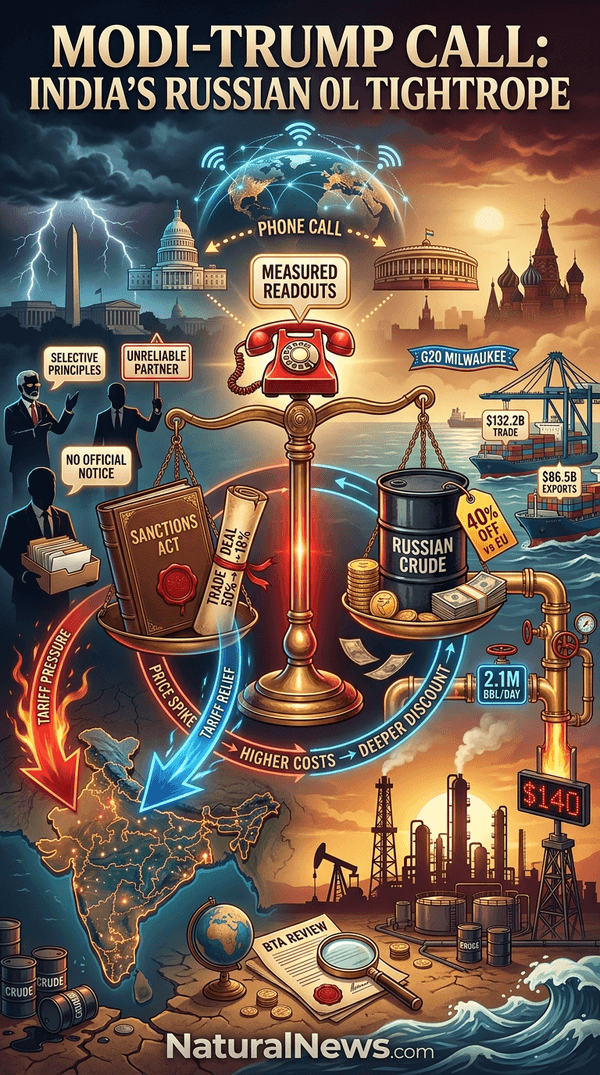
Explainer Infographic
Submit a correction >>
Tagged Under:
big government, cheap energy, Donald Trump, energy supply, foreign relations, fossil fuel, geopolitics, India, oil imports, politics, power, resist, Russia, Russian crude, Russian oil, sanctions, supply chain, tariffs, trade war, White House
This article may contain statements that reflect the opinion of the author
RECENT NEWS & ARTICLES